
Chiral molecules are non-superposable to their mirror images. The two images, called enantiomers, are defined by a left or right handedness in analogy to human hands. Enantiomers have essentially the same physical and chemical properties and can only be distinguished via their interaction with a chiral system, such as circularly polarized light or another chiral molecule.

Terrestrial life is homochiral. All the amino acids found in living terrestrial organisms have the same handedness. The origin of the homochirality, seen in biology, is hotly debated. A consequence of homochirality is that many biological processes are chiral-sensitive. For instance, two enantiomers of a given chemical species can have different flavors or healing properties. The identification of the left or right character of the molecules by chiral biological sensors is called chiral recognition. The understanding of the interaction of chiral species, and in particular the question of chiral recognition, are very important topics that would require unraveling the dynamical aspects of the processes.
Our group thus develops and implements new types of chiroptical spectroscopy, to track the ultrafast dynamics of chiral molecules at the femtosecond and attosecond timescales.
Universality of Photoelecton Circular Dichroism
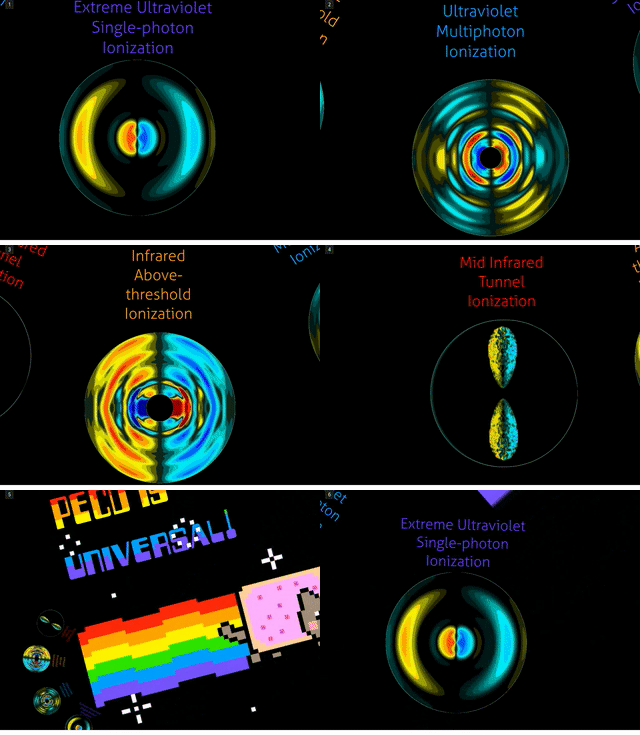
When circularly polarized light ionizes chiral molecules, more electrons are emitted forward or backward the light propagation axis. This asymetry, which reverses with the light helicity or molecule's handedness, is called Photo-Electron Circular Dichroism. PECD is an extremely sensitive probe of molecular chirality in the gas phase. We have investigated PECD in all ionization regimes, from the single XUV photon absorption to tunnel ionization by mid-infrared lasers, and found out that PECD was a universal effect.
Check out our paper and video abstract on New Journal of Physics
Time-resolved Photoelectron Circular dichroism
Unravelling the main initial dynamics responsible for chiral recognition could provide a valuable insight about many biological processes. However this challenging task requires a sensitive enantiospeci c probe to investigate molecular dynamics on their natural femtosecond timescale. Here we show that, in the gas phase, the ultrafast relaxation dynamics of photoexcited chiral molecules can be tracked by recording Time-Resolved PhotoElectron Circular Dichroism (TR-PECD) resulting from the photoionisation by a circularly polarized probe pulse. A large forward/backward asymmetry along the probe propagation axis is observed in the photoelectron angular distribution. Its evolution with pump-probe delay reveals ultrafast dynamics. We showed for the first time that PECD, which originates from the electron scattering in the chiral molecular potential, appears as a new sensitive observable for ultrafast molecular dynamics in chiral systems.
arXiv:1611.06226 or Journal of Physical Chemistry Letters 7, 4514 (2016)

Attosecond resolved photoionization
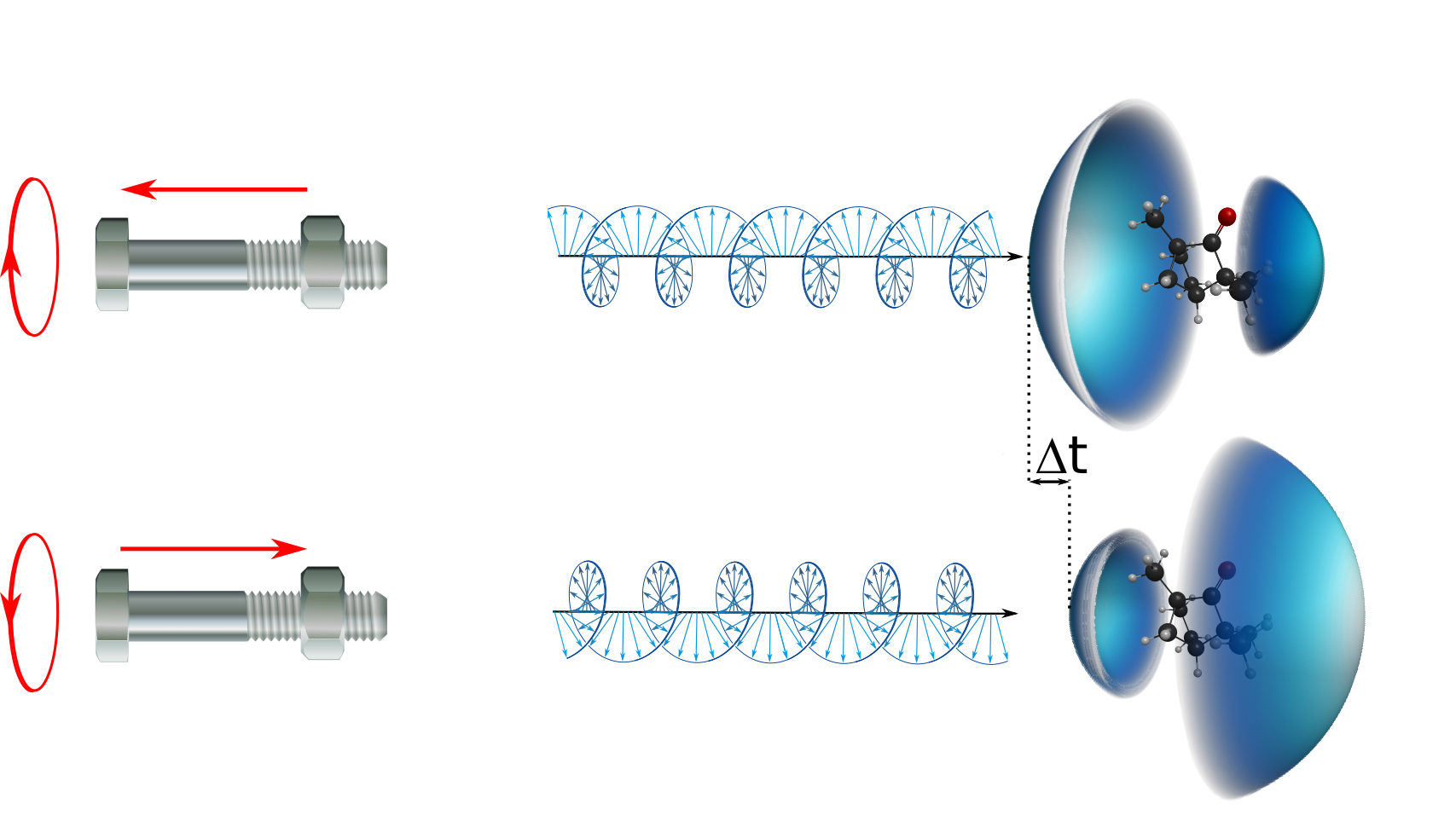
Just like a thread converts the rotation of a bolt into forward or backward translation depending on the rotation direction, chiral molecules eject electrons forward or backward when ionized by circularly polarized light. This effect, called Photoelectron Circular Dichroism, originates from the scattering of the electrons off the chiral potential. The asymmetric scattering electron dynamics induces a delay between the ejected electrons: we found out that the forward electrons were emitted 7 attoseconds before the backward ones.
Read more: http://www.inrs.ca/english/actualites/are-molecules-right-handed-or-left-handed
Article in Chemistry World: https://www.chemistryworld.com/news/chirality-probed-with-attosecond-precision/3008437.article
The article: S. Beaulieu et al., Science 358, 1288 (2017)
Photoexcitation circular dichroism
Chiral effects appear in a wide variety of natural phenomena and are of fundamental importance in science, from particle physics to metamaterials. The standard technique of chiral discrimination—photoabsorption circular dichroism—relies on the magnetic properties of a chiral medium and yields an extremely weak chiral response. We have proposed and demonstrated an orders of magnitude more sensitive type of circular dichroism in neutral molecules: photoexcitation circular dichroism. This technique does not rely on weak magnetic effects, but takes advantage of the coherent helical motion of bound electrons excited by ultrashort circularly polarized light. It results in an ultrafast chiral response and the efficient excitation of a macroscopic chiral density in an initially isotropic ensemble of randomly oriented chiral molecules. We have probed this excitation using linearly polarized laser pulses, without the aid of further chiral interactions. Our time-resolved study of vibronic chiral dynamics opens a way to the efficient initiation, control and monitoring of chiral chemical change in neutral molecules at the level of electrons.

Decoupling excitation and ionization steps in PECD
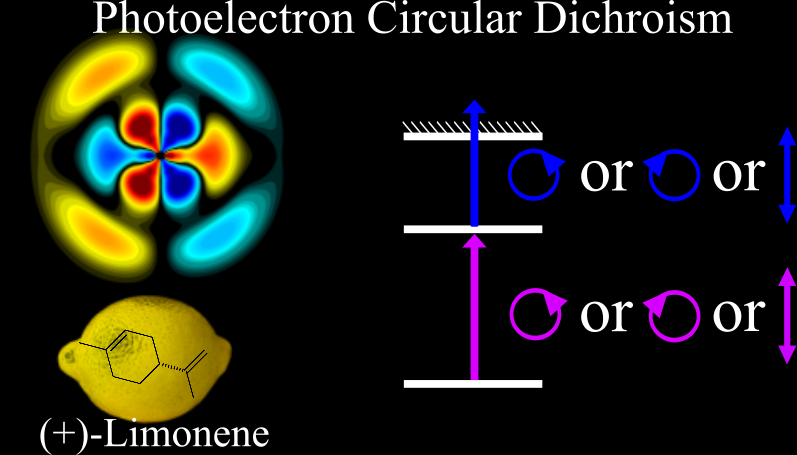
Multiphoton ionization by circularly polarized laser pulses is a powerful way to probe chiral molecules in the gas phase. The ionization process often involves going through intermediate states, in a resonance-enhanced multiphoton ionization scheme. The importance of these resonances in the photoelectron circular dichroism (PECD) remained unclear. To elucidate it, we decoupled the photoexcitation and photoionization steps, using two laser pulses with independent polarization states. We found that the ionizing photons had by far the greatest influence on the resulting PECD signal. Changing the helicity of the ionization laser pulse leads to a sign change of the PECD, while changing the helicity of the excitation laser pulse only slightly changes the magnitude of the PECD. We even observed PECD using a linearly polarized excitation laser pulse, as long as the ionization laser pulse was circularly polarized.
Scilight article on our work: https://aip.scitation.org/doi/10.1063/1.5060729
Multiphoton photoelectron circular dichroism of limonene with independent polarization state control of the bound-bound and bound-continuum transitions
S. Beaulieu, A. Comby, D. Descamps, S. Petit, F. Légaré, B. Fabre, V. Blanchet, and Y. Mairesse, The Journal of Chemical Physics 149, 134301 (2018); https://doi.org/10.1063/1.5042533

Fast chiral analysis by Photoelectron Elliptical Dichroism
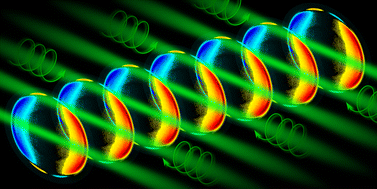
The fast and accurate analysis of chiral chemical mixtures is crucial for many applications but remains challenging. Here we use elliptically-polarized femtosecond laser pulses at high repetition rates to photoionize chiral molecules. The 3D photoelectron angular distribution produced provides molecular fingerprints, showing a strong forward-backward asymmetry which depends sensitively on the molecular structure and degree of ellipticity. Continuously scanning the laser ellipticity and analyzing the evolution of the rich, multi-dimensional molecular signatures allows us to observe real-time changes in the chemical and chiral content present with unprecedented speed and accuracy. We measure the enantiomeric excess of a compound with an accuracy of 0.4% in 10 min acquisition time, and follow the evolution of a mixture with an accuracy of 5% with a temporal resolution of 3 s. This method is even able to distinguish isomers, which cannot be easily distinguished by mass-spectrometry.
More recently, we have optimized this technique to determine enantiomeric excesses with a 0.04% precision:
Fast and precise chiroptical spectroscopy by photoelectron elliptical dichroism
A. Comby et al., Phys. Chem. Chem.Phys 25, 16246 (2023)
Photoionization by sub-cycle shaped laser fields
Strong field ionization is very sensitive to the temporal shape of the ionizing field, at the attosecond timescale. By combining several laser fields with different frequencies and polarizations, it is possible to control this temporal shape, to produce electric fields whose polarization state is more complex than circular or elliptical: it can switch handedness from one half cycle to the next. We have shown that such fields could be used to produce chiroptical effects in molecules, which switch sign every femtosecond.
Focus: Molecular Probe Uses a Polarization FlipFocus: Molecular Probe Uses a Polarization Flip
The results are published in Physical Review X:
Controlling Subcycle Optical Chirality in the Photoionization of Chiral Molecules,
Photoelectron Elliptical Dichroism Spectroscopy
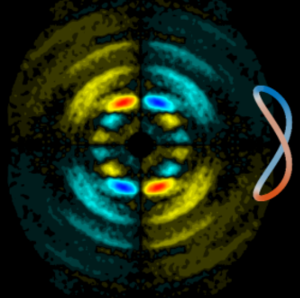
When chiral molecules are ionized by elliptically polarized laser pulses, a strong forward/backward asymmetry appears in the angular distribution of the photoelectrons. In this article published in PCCP, we use this PhotoElectron Elliptical Dichroism (PEELD) as a spectroscopic tool to investigate the influence of different Rydberg states in the resonance-enhanced multiphoton ionization of fenchone by tunable femtosecond pulses.

Chiral Laser Induced Electron Diffraction
Laser-induced electron diffraction is a technique enabling to probe the structure and dynamics of molecules with Angström spatial resolution and attosecond temporal resolution. We have recently shown that when elliptically polarized lasers are employed, LIED can distinguish the two mirror images of a chiral molecule.
Viewpoint in Physics:
https://physics.aps.org/articles/v17/26
The article:
https://journals.aps.org/prx/abstract/10.1103/PhysRevX.14.011015